
I’ve had the privilege of speaking on stages of every size, from university graduates taking their first steps into the professional world to senior executives navigating transformation. I’ve also worked with women entrepreneurs, international communities, and leaders exploring communication, leadership, and the future of work.
Every audience is different, as each organization has its own culture, and each event should have its own purpose and meaning.
Yet, after every keynote, I find myself asking the same question:
What will people actually do tomorrow because of what they heard today?
That question has become the foundation of how I approach every keynote I deliver.
Because while I genuinely enjoy inspiring an audience, I don’t believe inspiration alone creates change. Why? Simple: the event ends, the applause fades away, and what comes after is the day-to-day life.
People return to overflowing inboxes, urgent meetings, and demanding deadlines. Personal and professional responsibilities do take priority, and everything else has been forgotten.
If nothing changes after that, then even the most powerful keynote risks becoming simply another memorable moment rather than the beginning of meaningful transformation.
Key Takeaways: In My Experience
The most impactful keynote is not the one people remember. It is the one that quietly changes how they move forward.
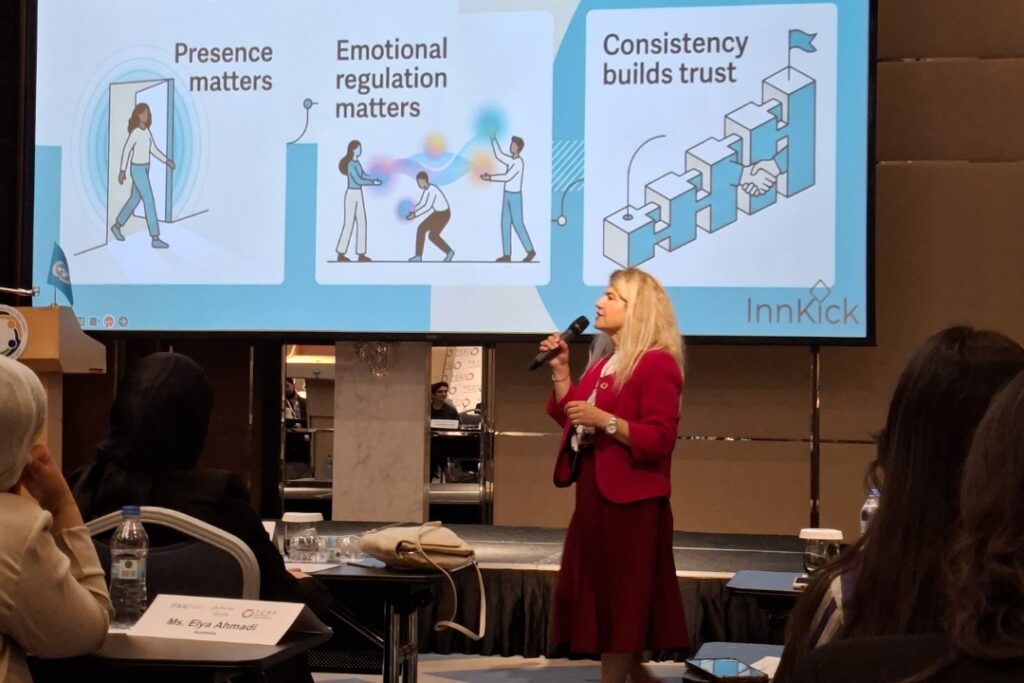
A Keynote Should Start the Conversation, Not Finish It
One of the biggest misconceptions about keynote speaking is that the speaker’s job ends when they leave the stage.
Personally, I see it differently. For me, a keynote is never the destination. It is a catalyst, a starting point, the fire that ignites your inner self.
My role is not to provide all the answers. My role is to encourage people to ask better questions; questions about their leadership, their communication, their mindset, their careers, and the impact they want to create. If you will, a bit of self-coaching. And creating a space in their mind, body, and soul to reflect, to pause, and to start to be aware.
When people leave the room still thinking, still discussing, and still challenging one another’s perspectives, I know something meaningful has happened.
The most rewarding moments often occur long after the event itself, when someone reaches out weeks later to tell me they finally had the difficult conversation they had been avoiding, accepted a leadership opportunity, or decided to make a change they had postponed for years.
That is the real success of a keynote.
Every Audience Already Has the Answers
One lesson I have learned throughout my corporate career, coaching practice, and keynote speaking is that people rarely need someone to tell them what to do.
More often than not, they need someone to create the space where they can think differently.
That is why I rarely want my audience to leave with a notebook full of quotations. Believe me, I use more images than verbiage anyway.
Instead, I hope they leave with one idea they cannot stop thinking about.
- One difficult conversation
- One action they are ready to take
- One networking event they will attend
- One micro goal to set for themselves
Sometimes the most powerful shift begins with a single question. And that’s what I want to spark in the audience’s mind.
Turning Inspiration into Action
Whenever I work with organizations, I encourage them to think beyond the event itself.
How will today’s message become part of tomorrow’s culture? What do you want the audience to take away? What kind of impact do you want to see in employees and in yourself? What habit change do you want to empower?
The organisations that create lasting impact are not necessarily those that host the biggest conferences or invite the most well-known speakers. They are the ones building on momentum.
- Perhaps managers continue the conversation
- Perhaps employees reflect together
- Perhaps coaching sessions or workshops reinforce the key messages.
Learning is rarely created in one moment. It is embedded through repetition, consistency, application, and follow-up. Not losing the momentum.
Leadership Sets the Tone
As someone who has spent more than three decades in international leadership before becoming a capacity builder and executive coach, I know first-hand that culture is shaped far more by behavior than by presentations.
Employees watch what leaders do. You are the role model.
If a keynote encourages curiosity, courageous communication, or collaboration, those behaviors need to be visible long after the event. That means a huge responsibility on the organization’s leaders, as they need to embrace the new idea, the new habit, the new inspiration, and take it forward. Live it and demonstrate that at the workplace.
Otherwise, even the most inspiring message loses credibility.
One reason I enjoy working with leadership teams is that they can transform inspiration into everyday practice. This is powerful but also frightening for the leaders. Nowadays, employees don’t expect perfect leaders. They expect someone who has a vision, walks the talk, is approachable, and compassionate.
That leads leaders to ask better questions, listen more intentionally, and create psychologically safe environments; people begin to believe that change is genuinely possible.

The Conversations I Remember Most
People sometimes ask me which keynote I enjoyed delivering the most.
Interestingly, my answer is rarely about the venue or the audience size.
It is about the conversations that followed.
The executive who admitted they had forgotten how to listen, the young professional who realized they had been waiting for permission instead of creating opportunities, the entrepreneur who finally decided to speak up about an idea they had been carrying for months.
Those conversations remind me why I continue doing this work.
Because speaking is not about delivering information.
It is about creating connection and building bridges.
Beyond Motivation
I have never wanted to be remembered simply as a motivational speaker.
Motivation is important, but it has a limited lifespan.
My goal is something deeper.
I want people to leave with greater clarity. Greater confidence, greater courage.
I want organizations to see stronger collaboration, more meaningful conversations, and leaders who communicate with greater authenticity.
If those changes begin because of something we explored together during a keynote, then I know the event has achieved its purpose.
My Final Thought
When organisations invite a keynote speaker, they are not simply filling a slot in an agenda.
They are creating an opportunity to influence how people think, communicate, and lead.
The real measure of success is not how loudly the audience applauds.
It is what happens when they return to work.
- Do they start different conversations?
- Do they approach challenges differently?
- Do they lead with greater intention?
- Do they take the first step they have been postponing?
